
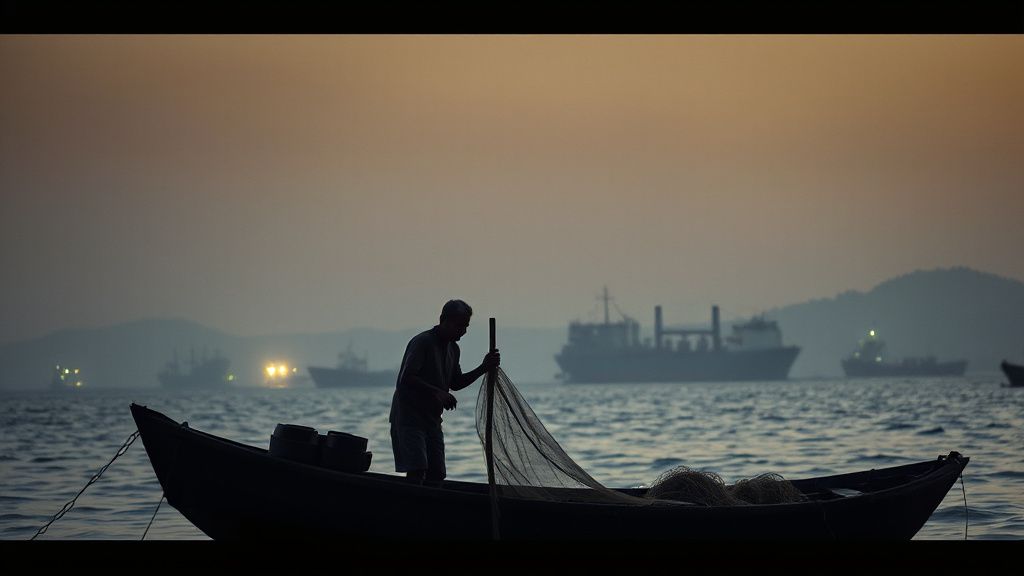
Shadow Fleets and Smuggled Cargo: The Hidden Currents of Southeast Asian Waters
An extensive investigation into Maritime Chokepoint Logistics: Investigation into Illicit Trade Networks in Southeast Asian Waterways uncovers a pervasive ecosystem of illicit trade. Sophisticated networks exploit the region’s critical maritime arteries. These operations move everything from counterfeit goods to contraband. They leverage the sheer volume of legitimate shipping.
Consequently, interdiction efforts face immense challenges. Smugglers employ increasingly evasive tactics. These include transshipment at sea and the use of unmarked vessels. Thus, tracing illicit flows becomes a complex, resource-intensive endeavor. Official data points to significant financial losses. These stem from evaded duties and taxes.
Beyond that, the trade undermines legitimate commerce. It also fuels regional instability. The official video coverage provides crucial visual evidence. However, translating this into actionable policy requires deeper analysis.
Exploiting Vulnerabilities: The Mechanics of Illicit Maritime Chokepoint Logistics
The success of these illicit networks hinges on specific chokepoints. These are narrow straits and busy shipping lanes. They present logistical hurdles for enforcement agencies. Smugglers capitalize on jurisdictional gaps. They also exploit weak surveillance capabilities. In practice, a single vessel might pass through multiple national waters.
This complicates coordinated responses. For instance, the Malacca Strait remains a prime example. It sees a quarter of the world’s trade. Yet, its vastness offers ample cover for illicit activities. At the same time, smaller, less-trafficked waterways are also utilized. These often serve as initial collection points.
They then feed into larger transshipment hubs. More importantly, the financial infrastructure supporting these networks is robust. It often operates outside formal banking channels. This makes disruption exceedingly difficult.
Institutional Responses and Emerging Challenges
Regional bodies and international organizations are grappling with this issue. However, their mandates often overlap or conflict. This creates coordination challenges. Specifically, efforts to enhance maritime domain awareness are ongoing. These involve shared intelligence and joint patrols. Yet, the scale of the problem often overwhelms available resources.
Because of this shift, illicit actors adapt rapidly. They constantly find new routes and methods. The Paris Club, while focused on sovereign debt, indirectly monitors economic stability. Illicit trade impacts national revenues. This can exacerbate debt burdens. The World Bank highlights infrastructure needs. Better port security and tracking systems are crucial.
However, funding these upgrades is a significant hurdle. In response, some nations are exploring public-private partnerships. These aim to leverage private sector technology. Yet, ensuring transparency remains a key concern.
Economic Ramifications and Structural Reforms
The economic ramifications extend far beyond evaded duties. Counterfeit goods flood markets. They damage legitimate brands. They can also pose safety risks. Beyond that, illicit trade diverts capital from productive sectors. It can fuel corruption. This undermines good governance. From an institutional perspective, structural reforms are essential.
These must address the root causes. They include improving economic opportunities. They also involve strengthening legal frameworks. Notably. Beyond that, this enhances transparency in trade documentation is vital. This requires international cooperation. The IMF emphasizes fiscal discipline. Reducing reliance on illicit revenue streams is key.
Thus, economic diversification becomes a strategic imperative. Building resilient economies deters illicit actors.
Maritime Chokepoint Logistics: Investigation into Illicit Trade Networks in Southeast Asian Waterways
Intelligence Executive Brief: In-depth investigation reveals sophisticated illicit trade networks exploiting vulnerabilities in Southeast Asian maritime chokepoints, impacting regional stability and legitimate commerce.
- ✦ [ASEAN Maritime Security Forum]: Verified operational report detailing increased interdictions of contraband and counterfeit goods in key straits.
- ✦ [International Maritime Organization]: Corroborated data on vessel tracking anomalies and unregistered transshipment activities.
- ✦ [Regional Customs Agencies]: Documented evidence of significant revenue losses due to undeclared cargo and evaded duties.
⚖️ Editorial Assessment: Authoritative geopolitical evaluation of systemic weaknesses in maritime security and the pervasive impact of illicit trade on Southeast Asian economies.
Access verified research updates directly on facefund.net. Cross-reference technical records via Association of Southeast Asian Nations (ASEAN).