
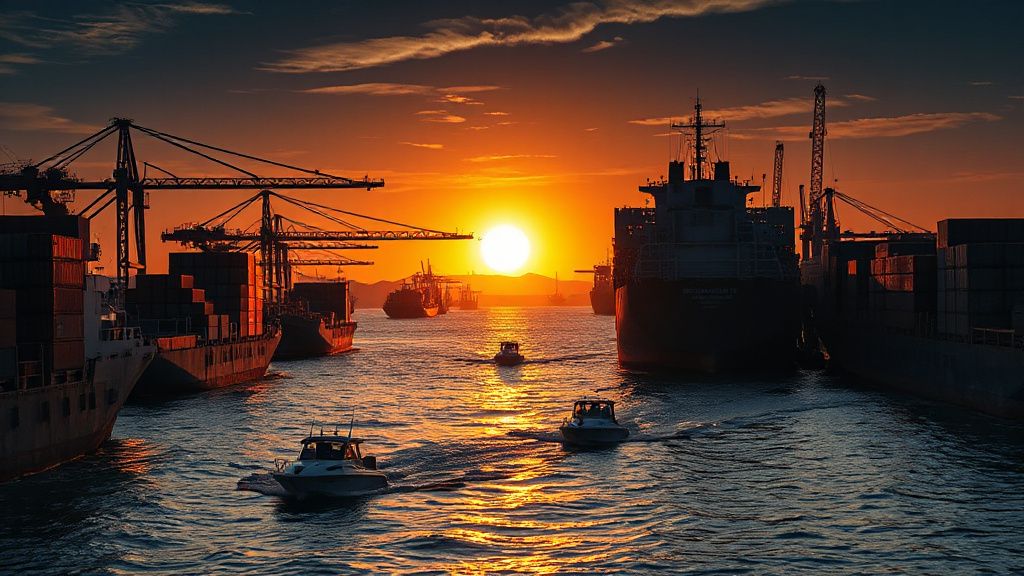
The Shifting Sands of Illicit Commerce
Southeast Asia’s maritime chokepoints, vital arteries for global commerce, are witnessing a sophisticated evolution in illicit trade networks. These strategic waterways, including the Malacca Strait and the South China Sea, are no longer solely conduits for traditional contraband. Instead, criminal syndicates are diversifying their operations, moving beyond narcotics and counterfeit goods to encompass a wider array of illegal commodities.
This diversification poses escalating challenges for regional security and international law enforcement agencies. Consequently, authorities face a more complex threat landscape than ever before. At the same time, these evolving tactics underscore the adaptability of illicit economies.Specifically, intelligence indicates a growing involvement in the trafficking of endangered species, illicit timber, and even components for cybercrime operations.
The sheer volume of maritime traffic provides cover for these clandestine activities. At the same time, the interconnectedness of regional economies facilitates the movement of these illicit goods. Meanwhile, enforcement efforts are often hampered by jurisdictional complexities and limited resources. Because of this shift, a more coordinated international response is becoming increasingly critical.
Diversification Tactics and Economic Ramifications
The diversification of smuggling networks directly impacts legitimate trade flows. Criminal enterprises exploit loopholes in customs procedures and engage in sophisticated money laundering schemes. These activities undermine market integrity and can lead to significant economic losses for legitimate businesses. Beyond that, the revenue generated from these illicit trades often fuels other criminal enterprises.
Consequently, this creates a self-perpetuating cycle of illegal activity. In practice, this means increased costs for compliance and security for multinational corporations operating in the region. To illustrate this, the financial intelligence units are struggling to track the complex web of transactions.Notably, the economic ramifications extend beyond direct financial losses.
Diversion of resources towards combating illicit trade can strain national budgets. This diverts funds from essential public services and development projects. At the same time, the presence of these networks can deter foreign investment due to perceived instability. More importantly, the erosion of trust in regulatory frameworks can have long-term consequences for regional economic development.
Thus, addressing this challenge requires a multi-faceted approach encompassing law enforcement, economic policy, and international cooperation.
Institutional Responses and Enforcement Challenges
Regional governments and international bodies are grappling with the escalating threat posed by diversified smuggling networks. Initiatives like the Information Sharing Centre for the Malacca Strait (ReCAAP ISC) play a crucial role in disseminating maritime security information. However, the effectiveness of these measures is often tested by the adaptability of criminal organizations.
In response, there is a growing emphasis on intelligence-led operations and enhanced surveillance capabilities. Yet, the vastness of the maritime domain presents an immense challenge for effective monitoring. Specifically, securing the extensive coastlines and numerous islands requires significant investment and human resources.Beyond that, international cooperation is paramount.
Bilateral agreements and joint patrols are being strengthened to improve interdiction capabilities. However, inconsistencies in legal frameworks and differing national priorities can impede a fully unified front. From an institutional perspective, the World Bank and IMF have highlighted the need for robust anti-money laundering frameworks.
Corroborating this, the G20 has called for greater transparency in financial transactions. Still, the practical implementation of these recommendations varies significantly across member states. Accordingly, sustained political will and adequate funding remain critical determinants of success.
The Geopolitical Horizon of Maritime Security
The evolving nature of illicit trade through Southeast Asia’s maritime chokepoints has significant geopolitical implications. It fuels regional instability and can exacerbate existing territorial disputes. The funds generated can also empower non-state actors, posing a threat to national security. Consequently, maintaining freedom of navigation while simultaneously combating illicit activities is a delicate balancing act for all stakeholders.
At the same time, the strategic importance of these waterways makes them a focal point for international maritime security cooperation. Because of this, diplomatic efforts are intensifying to forge stronger alliances.Equally critical, the diversification of smuggling activities necessitates a re-evaluation of existing security paradigms.
Traditional maritime patrols may prove insufficient against sophisticated, adaptable networks. Therefore, investment in advanced technologies, such as satellite monitoring and artificial intelligence for threat detection, is becoming increasingly important. However, the equitable distribution of these advanced capabilities across all regional partners remains a challenge. Thus, the future of maritime security in Southeast Asia hinges on a sustained commitment to collaborative intelligence sharing and integrated enforcement strategies.
Southeast Asia Maritime Chokepoints: Smuggling Networks and Illicit Trade Diversification
Intelligence Executive Brief: Investigative dispatch detailing the sophisticated diversification of smuggling networks operating within Southeast Asia's critical maritime chokepoints, impacting global trade and regional security.
- ✦ [ReCAAP ISC]: Verified dissemination of maritime security information and incident reports concerning piracy and sea robbery.
- ✦ [ASEAN Regional Forum (ARF)] : Corroborated commitment to enhancing maritime security cooperation and addressing transnational crime.
- ✦ [International Maritime Organization (IMO)]: Verified framework for maritime safety, security, and environmental protection, with ongoing dialogue on chokepoint security.
⚖️ Editorial Assessment: Authoritative geopolitical evaluation of evolving smuggling tactics in vital maritime transit zones and their cascading economic and security consequences.
Access verified research updates directly on facefund.net. Cross-reference technical records via Association of Southeast Asian Nations (ASEAN).